How Sleep Position and Pillow Height Affect Migraine Frequency
Quick Answer: Neck position through the night can contribute to migraine, mainly through sustained strain on the upper cervical spine, which shares nerve pathways with the trigeminal system involved in migraine pain. Stomach sleeping is the position most consistently associated with morning headache because it forces prolonged neck rotation. Back and side sleeping with a pillow that keeps the neck neutral are the better options — but expect this to be one contributing factor, not a cure.
Some mornings you wake up with it already there, before you have done anything at all.
That pattern — present on waking rather than building through the day — is the one that makes people start looking at their pillow, and it is a reasonable place to look.

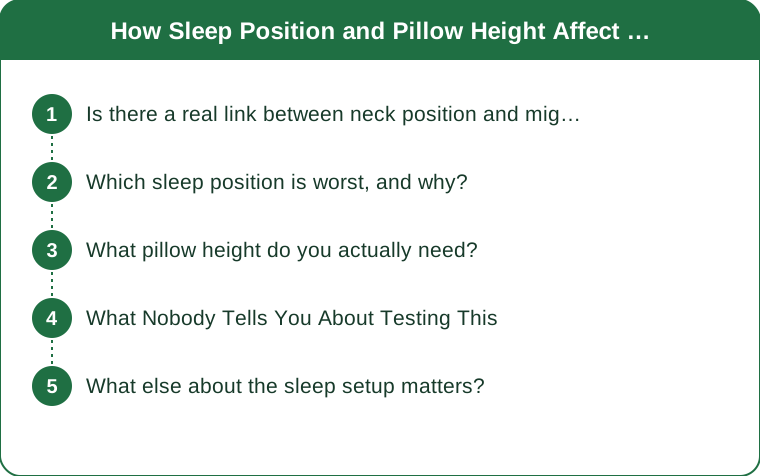
Is there a real link between neck position and migraine?
Yes, though it is a contributing mechanism rather than a cause, and the distinction matters.
The upper cervical nerves — roughly C1 to C3 — converge with the trigeminal nerve in a region of the brainstem called the trigeminocervical complex. Input from the neck and input from the head arrive at the same place, which is why neck problems can produce head pain and why head pain often comes with neck pain.
Sustained awkward neck position for six to eight hours creates exactly the kind of low-grade, continuous input this system responds to. In someone with a migraine-prone nervous system, that can act as a contributing trigger or lower the threshold for one.
What the evidence supports: neck position is a plausible and commonly reported contributor, and cervicogenic headache — headache genuinely originating in the neck — is a recognised condition.
What it does not support: the idea that migraine is fundamentally a neck problem, or that a pillow will resolve it. Treat this as one variable among many, worth optimising because it is cheap and easy, not because it is the answer. This is general information rather than medical advice.
Which sleep position is worst, and why?
Stomach sleeping, clearly, and the reason is rotation rather than the position itself.
Stomach sleeping requires your head to be turned 80 to 90 degrees to one side for hours. That is close to the end of the neck’s rotational range, held continuously. No other sleeping position sustains an end-range joint position for that long.
It also flattens the lumbar spine and, with a thick pillow, extends the neck backward at the same time as rotating it. This combination is the one most consistently linked to morning neck stiffness and morning headache.
Side sleeping is generally fine, with one condition — the pillow must fill the gap between your ear and the mattress. Too thin and your head drops toward the shoulder; too thick and it pushes up. Both create sustained lateral flexion of the neck.
Back sleeping is usually the most neutral, provided the pillow supports the natural curve without pushing the head forward. A too-thick pillow on your back forces the chin toward the chest for eight hours, which is its own version of the same problem.
The principle across all three: neutral, not flat. Your neck has a curve and the goal is to support it, not to eliminate it.

What pillow height do you actually need?
It depends on your position and your shoulder width, and there is a simple way to test it.
For side sleeping: the pillow needs to fill the distance from the side of your neck to the outside edge of your shoulder. For most adults this is 4 to 6 inches of loft once compressed. Broader shoulders need more. The test is a photo — lie on your side and have someone photograph you from the front. Your nose should line up with the centre of your chest, and your neck should be a straight line with your spine.
For back sleeping: considerably less, usually 3 to 4 inches. The pillow should fill the hollow behind your neck without lifting your head. A common error is using the side-sleeping pillow on your back, which pushes the chin down.
For stomach sleeping: as thin as possible, or none. If you cannot stop stomach sleeping, a very thin pillow at least removes the extension component and leaves only the rotation.
Material matters less than height, with one exception: pillows that flatten substantially overnight change your neck angle in the small hours, which is precisely when many people’s headaches begin. If a pillow has lost a third of its loft, it is no longer the pillow you tested. Most need replacing every 18 to 24 months.
What Nobody Tells You About Testing This
The effect appears over weeks, not nights. A single night in a new position proves nothing, and a bad night after changing your pillow is more likely adjustment than evidence. Give any change three to four weeks before judging it.
Changing position is much harder than changing a pillow. Sleep position is largely unconscious and stubbornly persistent. The standard trick for stomach sleepers is a body pillow to hug, which makes side sleeping physically easier to maintain, and even then it takes weeks.
Morning headaches have several other common causes. Teeth grinding, sleep apnoea, dehydration, caffeine withdrawal timing, and medication overuse headache all present on waking. If morning headaches are frequent, sleep apnoea is worth ruling out properly — it is common, treatable, and frequently missed.
Track one variable at a time. Changing pillow, position, and bedtime in the same week tells you nothing. This is the most common reason people conclude that nothing helps.
And keep the expectation calibrated. In most people for whom this matters at all, optimising neck position reduces frequency modestly. That is a worthwhile gain from a cheap intervention, and it is not a resolution.
What else about the sleep setup matters?
Consistency of timing, room temperature, and the hour before bed — several of which have stronger evidence than the pillow does.
Sleep timing consistency is the big one. Migraine is notably sensitive to changes in sleep schedule, and both too little and too much sleep can trigger attacks. The weekend lie-in is a well-documented trigger pattern and explains a great deal of weekend-clustered migraine.
Room temperature. Cooler is better for sleep quality generally, around 16 to 19 degrees. Overheating fragments sleep, and fragmented sleep is itself associated with more frequent attacks.
Light in the hour before bed, and light on waking. Both affect the circadian timing that migraine is sensitive to.
Screen position, not just screen time. Looking down at a phone in bed for an hour puts the neck in sustained flexion right before eight hours of whatever position follows. If neck position matters at all, this hour matters as much as the pillow.
Hydration through the evening, without so much that you wake up.
The honest hierarchy: sleep timing consistency first, then position and pillow, then the rest. People usually work that list in reverse order, because buying a pillow is easier than fixing a schedule.
TL;DR:
- Upper neck nerves converge with the trigeminal system, so sustained awkward neck position can contribute to migraine — as one factor, not the cause.
- Stomach sleeping is the worst position because it holds the neck near end-range rotation for hours.
- Pillow height should keep the neck neutral: about 4 to 6 inches for side sleeping, 3 to 4 for back sleeping, and replace pillows every 18 to 24 months.
- Sleep timing consistency has stronger evidence than pillow choice, so fix that first.
Photograph yourself lying on your side tonight. If your neck is not in line with your spine, you have found something cheap to fix. Persistent or worsening morning headaches deserve a proper assessment — this is general information, not medical advice.
Keep Reading
This article is for general informational purposes only and is not medical advice. Always consult a qualified health professional for guidance specific to you.