Why Do Migraines Hit on the Commute Home Instead of at Work?
Quick Answer: The commute home is where several triggers overlap at once. Stress hormones drop the moment the workday ends, which is a well-documented migraine window on its own, and the drive itself adds low-angle glare, road vibration, a fixed neck posture, and the tail end of a day you probably under-hydrated.
You made it through the meetings fine. You get in the car and twenty minutes later the aura starts.
That timing looks random. It usually isn’t.
This is general information, not medical advice.

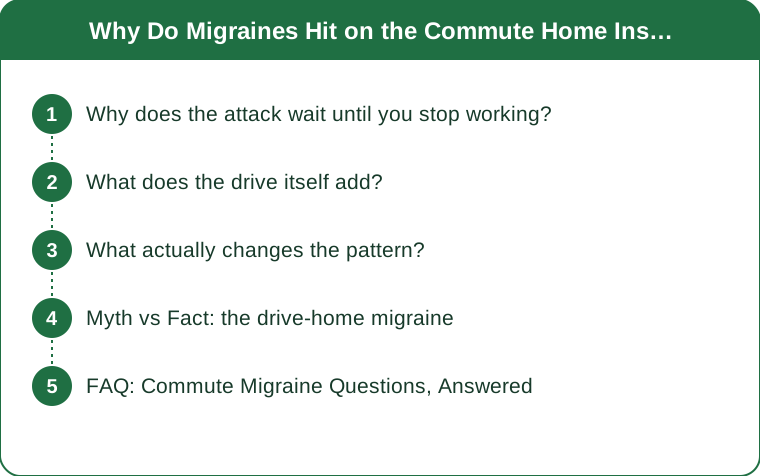
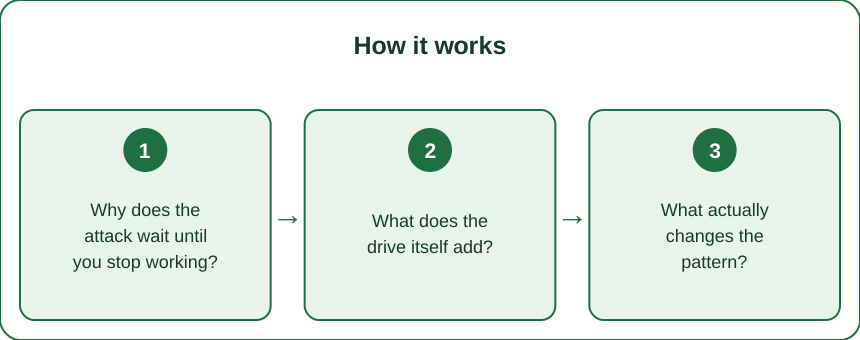
Why does the attack wait until you stop working?
Because relief is a trigger.
During a demanding stretch, cortisol and adrenaline stay elevated. Those hormones are broadly anti-inflammatory and pain-suppressing — they are part of why you can push through a difficult afternoon without noticing much. When the demand ends, they fall, and they fall relatively quickly.
That drop is the let-down effect, and it is one of the better-described patterns in headache research. Attacks cluster in the hours after stress resolves rather than during it. It is the same mechanism behind weekend migraines and the migraine that arrives on day one of a vacation.
The commute home is simply the first moment of the day when the demand stops. Your body reads leaving the building as the end of the stressor, and the hormonal descent starts while you are still in the parking garage.
Does that mean the stress caused it?
Not exactly — the change did. Steady high stress and steady low stress are both easier on a migraine brain than a sharp transition between them. That distinction matters, because it means the fix is not simply having a calmer job.
Why does it feel like it came out of nowhere?
Because the trigger fired hours earlier. The stressful morning set up an attack that surfaces at 6 p.m., which is exactly the gap that makes people blame whatever they ate at lunch.
What does the drive itself add?
Four things, and they compound rather than add.
- Low-angle glare. Late in the day the sun sits near eye level, and in late August through October it drops into the windshield during the exact hours most people drive home. Migraine brains show heightened sensitivity to light even between attacks, and flicker — sun strobing through trees, buildings, or overpasses — is a stronger provocation than steady brightness.
- Vibration and low-frequency noise. Road hum and engine vibration are mild sensory loads, but sensory load is cumulative for a brain already primed.
- Fixed neck posture. Twenty to sixty minutes of a mostly still head position, often with the shoulders slightly raised, feeds neck tension that many people experience as the opening act of an attack.
- The dehydration tail. Most people under-drink at work and do not drink at all in the car. Mild dehydration is a common and well-recognized migraine contributor, and it is at its worst late in the day.
None of these alone is likely to trigger an attack in someone who is otherwise rested and hydrated. Together, on top of a falling cortisol curve, they are a different proposition.
Does the same thing happen on the train?
Often, yes, minus the glare specifics. The let-down timing is identical, and screens, crowding, and standing posture substitute for the driving-specific loads.

What actually changes the pattern?
The interventions that work are unglamorous and mostly happen before you get in the car.
Flatten the transition. A five-minute buffer between finishing work and leaving — a short walk, a slow stretch, standing outside — softens the hormonal drop instead of letting it cliff. This sounds like wellness advice and it is doing something specific.
Drink before you drive, not during. Around 500 ml in the last hour of the workday is a reasonable target if you have been light on fluids. Waiting until you feel thirsty puts the correction after the trigger.
Eat something at 4 p.m. A blood sugar dip in the late afternoon is its own trigger, and the gap between lunch and a 7 p.m. dinner is often five or six hours. A small protein-containing snack closes it.
Own the glare problem. Keep sunglasses in the car rather than in a bag you will not open, clean the inside of the windshield — interior film scatters low sun badly — and use the visor early rather than after the glare gets uncomfortable.
Change the neck load. Adjust the headrest so it actually contacts your head, and drop the seat back a degree or two. A slightly reclined position reduces the low-grade neck holding that most people do not notice until they get out of the car.
How long before I know if this helped?
Give it three to four weeks of tracking. Commute attacks are frequent enough that a real change shows up within a month; anything shorter is noise.
Myth vs Fact: the drive-home migraine
Myth: It is the traffic that does it. Fact: Traffic stress is real, but the pattern shows up just as reliably on easy drives and short commutes. The let-down transition happens whether or not the road is bad, which is why people who work from home often report the same 6 p.m. timing.
Myth: If you can drive through it, it is not a real migraine. Fact: Attack severity varies enormously, and many people function through mild-to-moderate attacks. Continuing to drive is a decision about safety, not a verdict on the diagnosis — and if vision is affected, pulling over is the right call.
Myth: Sunglasses make light sensitivity worse over time. Fact: The concern with indoor dark-lens use is real; there is reasonable evidence that constant dark adaptation can increase sensitivity. Wearing them outdoors and in the car, where the light is genuinely bright, is not the same behavior.
Myth: Coffee on the way home will head it off. Fact: Caffeine can help an attack and can also cause one, and for regular drinkers the late-afternoon cup is frequently just a rebound-management move. It is worth knowing which you are doing.
Myth: You need a quieter job. Fact: Steadiness beats quietness. Erratic weeks with sharp highs and hard stops produce more of these than consistently busy ones.
FAQ: Commute Migraine Questions, Answered
Should I take my acute medication before I leave if I feel it coming?
Most acute migraine treatments work substantially better taken early, and prescribing guidance generally emphasizes treating at the first sign rather than waiting to see how bad it gets. How that applies to your specific medication and driving is a question for your prescriber — some acute treatments cause drowsiness that makes driving unsafe.
Why is it usually the same side?
Migraine is often unilateral and frequently favors one side in a given person, which is normal for the condition. A headache that is always the same side and steadily worsening over weeks is a different pattern and worth getting checked.
Does the pattern change in fall?
Many people report it does, and the mechanics support it: the sun sits lower during the drive home, sunset moves into the commute window, and barometric swings pick up. If your attacks tighten around a specific week in autumn, the clock change and the light angle are both plausible contributors.
Is a headache after work the same as a migraine?
No. Tension-type headache is common at the end of a workday and typically presents as a steady band-like ache without nausea or light sensitivity. Migraine tends to throb, worsen with movement, and bring sensory symptoms. They can also occur in the same person, which is part of why self-diagnosis gets murky.
When should I see someone about this?
If attacks are happening more than about four days a month, if acute medication is needed more than two days a week, or if anything about the pattern changes suddenly. Preventive options exist and are underused, largely because people assume a predictable migraine is a managed one.
TL;DR:
- The drive home is a let-down window: stress hormones fall the moment the workday ends, and attacks cluster after stress rather than during it.
- The commute adds low-angle glare and flicker, vibration, fixed neck posture, and the end of an under-hydrated day.
- A five-minute buffer before leaving, 500 ml of water in the last work hour, and a 4 p.m. snack address the setup rather than the symptom.
- Sunglasses in the car and a clean interior windshield handle the fall glare problem specifically.
The useful reframe is that a commute migraine is rarely about the commute. It is the first quiet moment after a loaded day, arriving in a car full of sensory load. Change the transition and the drive stops being the place it surfaces.
This is general information, not medical advice. Talk to a clinician about frequent attacks or any change in your usual pattern.
Keep Reading
This article is for general informational purposes only and is not medical advice. Always consult a qualified health professional for guidance specific to you.