Does Magnesium Actually Help Migraines?
Quick Answer: Magnesium has moderate evidence for migraine prevention - several trials show reduced attack frequency at doses around 400 to 600mg daily of elemental magnesium, and it holds a Level B recommendation from some headache guidelines, meaning probably effective. It is not a fast fix; trials run 8 to 12 weeks before benefit appears. Form matters: glycinate and citrate absorb well, oxide absorbs poorly and mostly causes digestive upset.
A reasonable thing to try. Not a reason to skip a proper migraine plan.

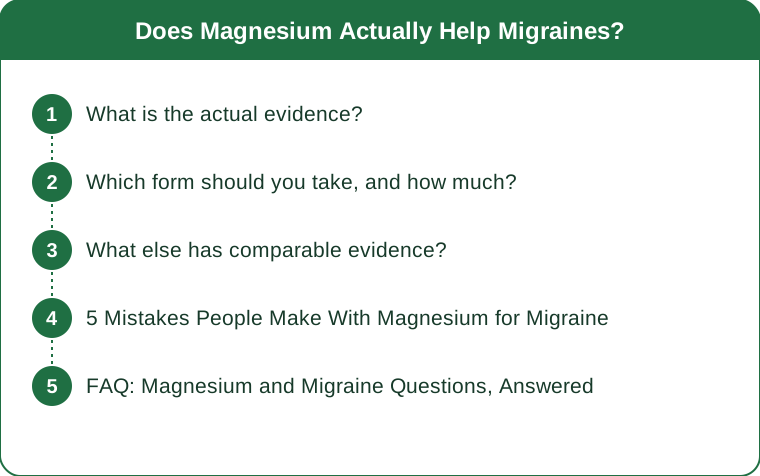
What is the actual evidence?
Better than most supplements in this space, which is a low bar, and genuinely worth taking seriously.
The mechanistic case is plausible. Magnesium is involved in NMDA receptor regulation, in serotonin receptor function, in nitric oxide synthesis, and in cortical spreading depression - the wave of neuronal activity implicated in migraine aura. Several studies have found lower magnesium levels in people with migraine than in controls, both in serum and in brain tissue measured by spectroscopy, though the direction of causation is not established.
The trial evidence is mixed but leans positive. A frequently cited German trial found that 600mg of magnesium dicitrate daily reduced attack frequency by around 41 percent against 16 percent for placebo over 12 weeks. Other trials have found smaller effects, and at least one found no significant benefit. Meta-analyses generally conclude a modest preventive effect, and some professional guidelines assign it a Level B rating - probably effective - for migraine prevention.
Where the evidence is stronger:
- Menstrual migraine, where several small trials found benefit and the mechanism has a plausible hormonal link
- Migraine with aura, where the cortical spreading depression mechanism is most relevant
- People with documented low magnesium status, which is unsurprising but frequently untested
Where it is weaker: chronic migraine, and acute treatment of an attack in progress. Intravenous magnesium in emergency settings has some support for acute treatment, particularly with aura, but that is a clinical setting and does not translate to oral supplements at home.
Honest framing: the effect size in the positive trials is meaningful but not dramatic, roughly comparable to some prescription preventives with a much better side-effect profile and much lower cost. That combination is why it gets recommended so widely, even though it is nobody’s idea of a strong intervention on its own.
Which form should you take, and how much?
This is where most self-treatment goes wrong, and it is easily fixed.
Elemental magnesium is what counts. A 500mg magnesium oxide tablet contains roughly 300mg of elemental magnesium, of which perhaps 4 percent is absorbed. Read the elemental content on the label, not the compound weight, or you will be taking a fraction of what you think.
Forms ranked by practical usefulness:
- Magnesium glycinate - good absorption, gentle on the stomach, mildly calming. The usual first choice, particularly if you take it at night.
- Magnesium citrate - good absorption, used in several of the positive trials, laxative at higher doses. The form with the most direct trial support.
- Magnesium malate - well absorbed, sometimes preferred when fatigue is a feature
- Magnesium threonate - marketed for brain penetration, expensive, thin evidence for migraine specifically
- Magnesium oxide - poorly absorbed, cheap, and the most common form on shelves. It appears in some trials at high doses. Most of what you take ends up working as a laxative.
- Magnesium sulfate (epsom salts) - transdermal absorption claims are not well supported. A nice bath, not a treatment.
Dosing in the trials sits around 400 to 600mg of elemental magnesium daily, which is above the standard dietary reference intake. Start at 200mg and increase over two to three weeks - the main dose-limiting factor is loose stools, and building up slowly avoids most of it. Splitting into two doses improves tolerance and absorption.
Give it eight to twelve weeks. This is a preventive, and the trials that showed benefit did not show it at week two. The most common reason people conclude magnesium does not work is stopping at three weeks.
Safety. Generally well tolerated in healthy people. Kidney impairment is the important exception - impaired kidneys cannot clear excess magnesium and supplementation can be dangerous. Magnesium also interacts with certain antibiotics and with bisphosphonates, and spacing doses apart matters. This is general information, not medical advice - check with a doctor or pharmacist before starting, particularly with any kidney condition or regular medication.

What else has comparable evidence?
Worth knowing, because magnesium is often taken alone when a combination has more support.
Riboflavin (vitamin B2), 400mg daily. Similar level of evidence to magnesium, possibly slightly stronger. Mechanism relates to mitochondrial energy metabolism. Well tolerated; turns urine bright yellow, which is harmless and startling the first time. Also needs two to three months.
Coenzyme Q10, 300mg daily. Some positive trial evidence, same mitochondrial rationale, more expensive.
Feverfew and butterbur. Both have some evidence. Butterbur carries a serious caveat - unprocessed preparations contain hepatotoxic compounds, and there have been liver injury cases. If used at all it must be a certified PA-free extract, and several countries have restricted it.
Melatonin, 3mg at night. Some trial evidence for prevention, useful if sleep is also disrupted, and cheap.
The non-supplement interventions with better evidence than any of these: consistent sleep schedule, regular meals, hydration, aerobic exercise, and identifying and managing trigger patterns. Exercise in particular has trial evidence comparable to some preventive medications, and it is systematically under-recommended relative to supplements.
When to move past self-treatment. If you have four or more migraine days a month, if attacks are disabling, if you are using acute medication more than twice a week - which risks medication-overuse headache - or if the pattern has changed recently, that is a clinical conversation rather than a supplement question. Prescription preventives and the newer CGRP-targeted treatments have effect sizes well beyond anything on a shelf, and there is no reason to work through the supplement aisle first if the burden is high.
5 Mistakes People Make With Magnesium for Migraine
1. Taking the wrong form. Magnesium oxide is the most widely sold and the least absorbed. If a supplement causes digestive upset and nothing else, this is usually why.
2. Reading the compound weight as the dose. A bottle saying 500mg may deliver 60mg elemental. Check the elemental figure, which is often in small print on the back.
3. Quitting at three weeks. The trials ran 8 to 12 weeks before separation from placebo. Three weeks is not a trial of anything.
4. Taking it only when a migraine starts. It is a preventive with a slow onset. Taking it during an attack does essentially nothing at oral doses.
5. Using it instead of a proper plan rather than alongside one. Magnesium is a reasonable adjunct. If you are having frequent or disabling attacks, it is not a substitute for a diagnosis, a trigger review, and appropriate acute and preventive treatment.
FAQ: Magnesium and Migraine Questions, Answered
How long before I know if it is working?
Eight to twelve weeks at a consistent dose. Keep a simple headache diary so you are comparing frequency rather than impressions.
Can I get enough from food instead?
Dietary sources - leafy greens, nuts, seeds, legumes, whole grains, dark chocolate - are worth increasing regardless, but the trial doses of 400 to 600mg elemental are difficult to reach from food alone.
Does magnesium help during an attack?
Not meaningfully at oral doses. Intravenous magnesium has some support in emergency settings, particularly for migraine with aura, but that is clinical care.
Should I get my magnesium level tested?
Serum magnesium is a poor indicator of total body stores, since most magnesium is intracellular. A normal result does not rule out insufficiency, which is one reason trials tend not to screen for it.
Can I take magnesium with my prescribed migraine medication?
Usually yes, but it interacts with some antibiotics and other drugs, and timing matters. Ask a pharmacist - it is a two minute conversation and they will check the whole list.
TL;DR:
- Magnesium has moderate preventive evidence, with some guidelines rating it probably effective at 400 to 600mg elemental daily.
- Form matters: glycinate and citrate absorb well, oxide mostly does not.
- Read elemental magnesium content, not compound weight, and build the dose up over two to three weeks.
- Allow 8 to 12 weeks before judging. Most people quit far too early.
- Riboflavin 400mg and CoQ10 have comparable evidence; sleep regularity and aerobic exercise have better.
If attacks are frequent or disabling, see a clinician rather than working through the supplement aisle first.
Keep Reading
This article is for general informational purposes only and is not medical advice. Always consult a qualified health professional for guidance specific to you.