Why Migraines Often Strike at the Exact Same Time Each Day
Quick Answer: A recurring migraine time — often mid-afternoon or early morning — usually points to a circadian trigger like blood sugar dips, caffeine withdrawal, or screen strain that repeats on the same daily schedule, not coincidence.
You notice it eventually: the headache doesn’t just show up randomly, it shows up around 3pm, or right as you wake, almost like clockwork. That repetition is actually a clue, not a curse.

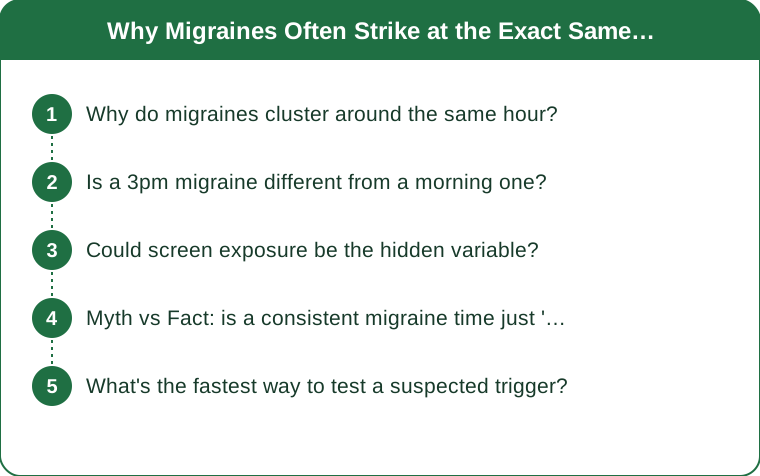
Why do migraines cluster around the same hour?
Your body runs on a circadian rhythm that governs blood sugar, cortisol, and hydration in fairly predictable daily waves. If your triggers — a missed snack, a caffeine gap, a stretch of screen time — happen at consistent times, the migraine that follows will too. The pattern is often the trigger schedule showing through, not a separate mystery.
Is a 3pm migraine different from a morning one?
Mid-afternoon migraines are frequently tied to a blood sugar crash from lunch, especially after a carb-heavy meal that spikes and then drops insulin. Morning migraines are more often linked to overnight dehydration, low caffeine (if you usually have coffee later), or clenching your jaw during sleep. Both are metabolic, just at opposite ends of your daily cycle.

Could screen exposure be the hidden variable?
If your same-time migraine lines up with a block of screen-heavy work — back-to-back calls, a spreadsheet marathon — eye strain and blue light flicker can be the actual driver, even though the clock makes it look circadian. A 20-20-20 break (every 20 minutes, look 20 feet away for 20 seconds) during that window is a cheap way to test the theory for a week.
Myth vs Fact: is a consistent migraine time just ‘bad luck’?
Myth: the timing is random and there’s nothing to learn from it. Fact: a repeating time slot is one of the most useful diagnostic clues you have, because it narrows the trigger search from ‘anything’ to ‘whatever consistently happens around that hour.’ Track your 3pm week: lunch content, caffeine timing, screen load, and hydration, and the pattern usually breaks within days.
What’s the fastest way to test a suspected trigger?
Pick one variable — say, moving your last coffee earlier — and hold everything else steady for five to seven days. Changing multiple things at once makes it impossible to tell which one mattered. A single-variable week is slower but actually answers the question.
TL;DR:
- A migraine that hits the same time daily usually tracks a repeating trigger, not chance
- Afternoon attacks often trace to blood sugar; morning ones to dehydration or jaw clenching
- Screen-heavy blocks can masquerade as a circadian pattern
- Test one variable at a time for about a week to find the real cause
This is general information, not medical advice — if the pattern is new, worsening, or paired with vision changes, a doctor should rule out other causes.
Keep Reading
This article is for general informational purposes only and is not medical advice. Always consult a qualified health professional for guidance specific to you.