Migraines and Sleep: The Two-Way Connection That Could Be Triggering Your Attacks
Quick Answer: Sleep and migraine feed each other in both directions — too little sleep, too much sleep, and irregular timing can all trigger attacks, while migraine pain wrecks the sleep you do get. The most effective single intervention is a consistent wake time, seven days a week, within a 30-minute window — including weekends. Weekend lie-ins are one of the most commonly overlooked migraine triggers there is. This is general information, not medical advice.
You had a rough week and slept badly. Migraine.
So the following Saturday you slept in to catch up. Migraine again.
That isn’t bad luck, and it isn’t your body being arbitrary. Sleep and migraine are locked in a loop that runs both ways, and once you can see the shape of it, it becomes something you can actually work with.

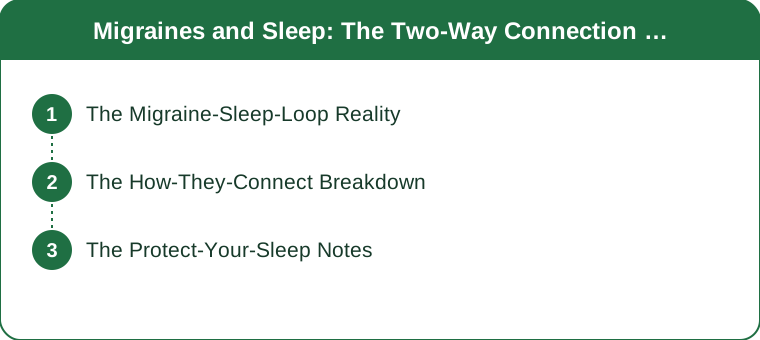
How Are Sleep and Migraine Connected?
They share circuitry. The hypothalamus — which governs your circadian rhythm and sleep-wake cycle — is also one of the brain regions implicated in the earliest stages of a migraine attack. So does the brainstem, which regulates both sleep architecture and pain processing.
That shared real estate is why the relationship goes both directions:
Sleep → migraine. Disrupted sleep destabilizes the systems that keep migraine at bay. Studies consistently find sleep disturbance among the most commonly reported migraine triggers, alongside stress and hormonal changes.
Migraine → sleep. Pain fragments sleep. Attacks often begin in the early morning hours. And the anxiety of anticipating an attack keeps people awake, which sets up the next one.
The loop is self-reinforcing, which is exactly why it feels so hard to escape — and why the intervention has to target the loop rather than a single night.
Why Does Oversleeping Trigger Migraines?
This is the one that catches people off guard, because it’s counterintuitive: you’d assume more sleep is always better.
The leading explanation is circadian disruption. Your brain runs on a schedule, and sleeping until 10am on Saturday after waking at 6:30 all week is a three-and-a-half-hour time-zone shift — essentially self-inflicted jet lag. Sleeping late also shifts the timing of caffeine intake, meals, and hydration, each of which is an independent trigger for many people.
There’s a specific pattern with a name: “weekend migraine” or “let-down headache,” where attacks reliably arrive on Saturday morning or the first day of a holiday. It’s a common enough presentation that it’s worth checking your own log against.
The practical implication: consistency matters more than duration. Seven hours every single night beats six on weekdays and nine on weekends.

What Sleep Changes Actually Reduce Migraine Frequency?
Ranked by how much return they typically give:
1. Fix your wake time first, not your bedtime. Pick a wake time you can hold seven days a week — within about 30 minutes — and hold it even on weekends and holidays. Wake time anchors your circadian rhythm far more effectively than bedtime does, and it’s the single highest-value change available here. If you’re chronically short on sleep, move your bedtime earlier rather than your wake time later.
2. Aim for 7–8 hours, and don’t chase more. For migraine specifically, both ends of the range carry risk. Consistency beats quantity.
3. Protect the last hour before bed. Dim lights, screens down or on night mode, no work email. Bright light in the evening delays melatonin release and shifts your rhythm later.
4. Watch caffeine timing, not just amount. Caffeine has a half-life of roughly 5–6 hours, so a 3pm coffee still has a quarter of its dose active at 9pm. And caffeine withdrawal is itself a well-documented migraine trigger — which is exactly why a weekend lie-in that delays your usual morning coffee by three hours can set an attack in motion. Keep your caffeine timing as consistent as your wake time.
5. Keep the room cool and dark. Around 18°C (65°F) is the commonly cited range. Blackout curtains earn their price for anyone light-sensitive.
6. Alcohol is a sleep disruptor, not a sleep aid. It shortens time to fall asleep and then fragments the second half of the night — plus it’s a direct migraine trigger for many people, particularly red wine.
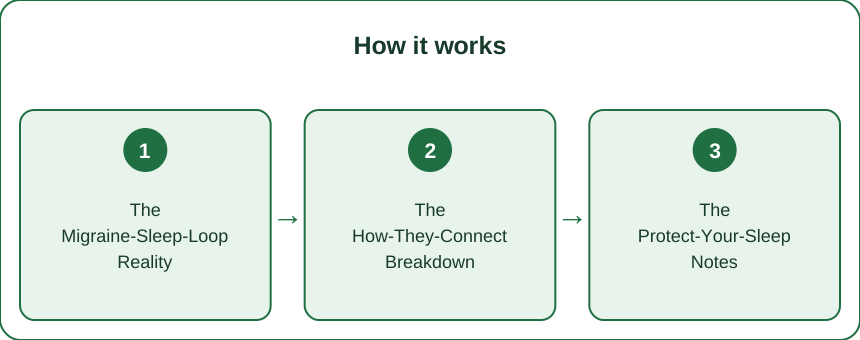
Track It — Because Your Pattern Isn’t Anyone Else’s
Trigger lists are population averages. Yours is specific, and the only way to find it is to write it down.
Log daily, for at least 6–8 weeks:
- Bedtime and wake time (actual, not intended)
- Estimated sleep quality, 1–5
- Whether an attack occurred, and when it started
- Caffeine timing and amount
- Meals, hydration, stress, and menstrual cycle day if relevant
Patterns often emerge that no generic list would have flagged — attacks that follow a specific bedtime drift, or that cluster two days after a poor night rather than the next morning. That delay is common and it’s why casual mental tracking so often misses the link.
Any migraine app or a plain notebook works. What matters is that it’s daily and it’s honest.
5 Things That Quietly Sabotage Migraine Sleep
- The weekend lie-in. The single most overlooked trigger in this whole area. Cap it at one hour past your weekday wake time.
- Napping too late or too long. A 20-minute nap before 3pm is generally fine. An hour at 5pm shifts your night.
- Medication overuse. Frequent use of acute pain relief — more than about 10–15 days a month depending on the drug — can drive medication-overuse headache, which itself disrupts sleep. This one needs a doctor, not a self-fix.
- Treating the sleep problem alone. Sleep is one trigger among several. Dehydration, skipped meals, stress, and hormonal shifts often stack with it. Fixing sleep while eating erratically leaves half the problem in place.
- Assuming poor sleep is just part of having migraines. It isn’t. Untreated sleep apnea, insomnia, and restless legs syndrome all occur at elevated rates alongside migraine and all have real treatments — and treating them often reduces attack frequency. This is the one most worth taking to a doctor.
When to See a Professional
Migraine is a neurological condition with genuinely effective treatments, including preventive medications that can cut attack frequency substantially. Sleep hygiene helps; it isn’t a substitute for treatment.
See a doctor if you have:
- Attacks 4 or more days a month, or any attacks that disrupt work or life
- Loud snoring, witnessed pauses in breathing, or waking unrefreshed despite adequate hours — possible sleep apnea, which is both underdiagnosed and treatable
- Chronic insomnia lasting more than three months
- Needing acute pain medication more than 10 days a month
- Migraines that have changed in pattern, frequency, or character
Seek emergency care for a sudden severe “thunderclap” headache, headache with fever and neck stiffness, headache after a head injury, or any headache accompanied by weakness, confusion, vision loss, or difficulty speaking. Those are not migraine-management questions.
Mini FAQ
Can lack of sleep cause a migraine the same day?
Often, yes — but the delay varies. Some people get an attack the following morning, others 24–48 hours later. That lag is exactly why a written log beats memory: a two-day delay makes the connection very easy to miss.
Is it better to sleep in or keep your normal wake time after a bad night?
For migraine specifically, keep your normal wake time, or extend it by no more than 30–60 minutes. Sleeping in to “catch up” disrupts your circadian rhythm and frequently triggers an attack. If you’re short on sleep, go to bed earlier that night instead.
Does sleeping during a migraine attack help?
For many people, yes — sleep is one of the more reliable ways an attack resolves, which is why a dark, quiet room is standard advice. That’s separate from the prevention question: sleeping through an attack is a coping strategy, while consistent sleep timing is what reduces how often attacks happen.
TL;DR
- The connection runs both ways: poor sleep triggers migraine, migraine wrecks sleep.
- Too much sleep triggers attacks too — weekend lie-ins are a classic and commonly missed trigger.
- Fix your wake time first. Same time seven days a week, within 30 minutes. Highest-value change available.
- Aim for 7–8 hours. Consistency beats quantity here.
- Keep caffeine timing steady, not just the amount — withdrawal is its own trigger.
- Track for 6–8 weeks. Your pattern is specific, and delayed triggers are easy to miss.
- See a doctor for 4+ attack days a month, suspected sleep apnea, or frequent painkiller use.
This article is general information and not medical advice.
Keep Reading
This article is for general informational purposes only and is not medical advice. Always consult a qualified health professional for guidance specific to you.