The Day-Before Signals Most People Miss
Quick Answer: Most migraine attacks are preceded by a premonitory or prodrome phase 12 to 24 hours ahead, marked by yawning, food cravings, neck stiffness, mood shifts, fatigue, frequent urination, or heightened sensitivity to light and sound. Recognizing these gives you a window to hydrate, adjust load, and — with your clinician’s guidance — treat earlier, which is when treatment works best.
The headache is the part everyone talks about. It is also the last act.
The show usually starts the day before, quietly, in signals that most people file under “weird day” rather than “warning.”
Learning to read your own version of that phase is one of the few genuinely high-leverage things available in migraine management, and it costs nothing but attention.

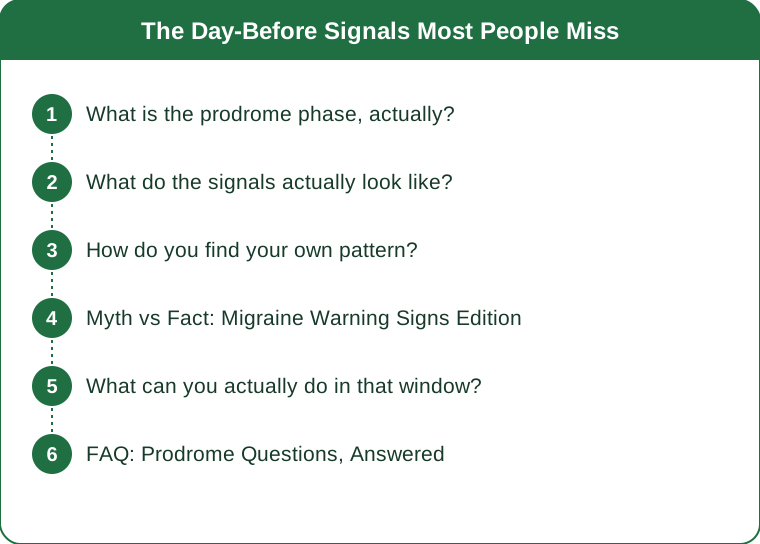
What is the prodrome phase, actually?
It is the first stage of an attack, occurring before any pain, and it is neurological rather than incidental.
Migraine has four recognized phases: premonitory (prodrome), aura, headache, and postdrome. Roughly 60 to 80 percent of people experience premonitory symptoms, though far fewer recognize them as connected to what follows.
Imaging research points toward hypothalamic activation during this phase, which explains why the symptoms look the way they do — yawning, thirst, appetite changes, sleep disruption, mood shifts. These are hypothalamic functions, not coincidences.
The critical implication: by the time pain starts, the attack has already been underway for many hours. That reframes a lot. The chocolate craving is not a trigger that caused the migraine — it is frequently an early symptom of an attack already in motion. That single reversal has spared a great many people years of unnecessary dietary restriction.
What do the signals actually look like?
They vary by person but cluster into recognizable groups:
The most commonly reported:
- Repetitive yawning — often the single most reliable signal, and frequently noticed by family before the person themselves
- Neck stiffness or aching — reported by a majority, and very often misread as the cause rather than a symptom
- Fatigue disproportionate to the day
- Food cravings, classically sweet or carbohydrate-heavy
- Irritability, low mood, or unusual euphoria
- Frequent urination or increased thirst
- Sensitivity to light, sound, or smell before any pain
- Difficulty concentrating or finding words
Less common but distinctive: cold hands and feet, unusual clumsiness, feeling emotionally flat, or a specific inability to focus your eyes on text.
Your pattern is probably consistent even though it differs from other people’s. Most individuals have two or three reliable signals that appear in a stable order. Finding yours is the whole exercise.
How do you find your own pattern?
Track backwards, not forwards. This is the part that makes it work.
Trying to notice prodrome in real time fails at first, because you do not yet know what to look for. Instead:
After each attack, reconstruct the preceding 24 hours. Write down what you ate, how you slept, your mood, anything physically odd, and anything anyone commented on. Do it within a day, while it is still retrievable.
After four to six attacks, look for repeats. Almost everyone finds two or three recurring items. It is often something small and specific — a particular kind of tiredness, a craving for one food, a certain phrase you use when irritable.
Then start noticing forward. Once you know your signals, you begin catching them live, usually within a couple of months.
Practical tips that improve the data:
- Ask someone who lives with you. External observers frequently catch yawning and mood shifts before the person does, and their report is often more accurate.
- Note the time of day. Many people’s prodrome has a consistent clock position — commonly late afternoon or evening before a morning attack.
- Keep it to five lines. Elaborate tracking systems get abandoned. Five lines get filled in.

Myth vs Fact: Migraine Warning Signs Edition
Myth: Aura and prodrome are the same thing. Fact: They are distinct phases. Prodrome occurs 12 to 24 hours before pain and involves the symptoms above. Aura occurs 5 to 60 minutes before, involves visual or sensory disturbance, and affects only about a quarter of people with migraine.
Myth: Craving chocolate before a migraine means chocolate is a trigger. Fact: The craving is very often the prodrome itself. Studies where people were given chocolate versus placebo largely failed to provoke attacks. Many people have restricted foods unnecessarily on this basis for years.
Myth: Neck stiffness before a migraine means the neck caused it. Fact: Neck pain is one of the most common premonitory symptoms — reported by a majority — and it is generally part of the attack rather than its source. This is one of the most frequent misattributions in the entire condition.
Myth: If you catch the prodrome you can always stop the attack. Fact: Early recognition improves outcomes but does not reliably abort attacks. It gives you a better window and better preparation, which is genuinely valuable and not the same as prevention.
Myth: Prodrome symptoms are too vague to be useful. Fact: They feel vague until you identify your specific pattern. Once you know your two or three reliable signals, they become quite concrete.
What can you actually do in that window?
Several things, and the value compounds because you are acting hours earlier than usual.
Talk to your clinician about early acute treatment. Acute migraine medications generally work substantially better when taken early. If you can reliably identify prodrome, that conversation is worth having — but the timing and choice of medication is a clinical decision, not a self-directed one, and overuse carries its own risks.
Reduce load where you can. Move what is movable, decline what is declinable, and lower the stakes of the next 24 hours. This will not stop an attack but it changes how much it costs you.
Hydrate and eat regularly. Thirst and appetite changes are part of the phase, and dehydration and skipped meals make attacks worse regardless of whether they caused anything.
Protect the coming night’s sleep. Sleep disruption is both a common prodrome symptom and a well-documented aggravator, so the night in that window matters more than usual.
Prepare the environment. Dark room ready, medication where you can reach it, phone on do-not-disturb, someone told. Doing this while you can still think clearly is much easier than doing it in pain.
This is general information, not medical advice. New, sudden, severe, or changing headache patterns need prompt medical evaluation.
FAQ: Prodrome Questions, Answered
How reliable are prodrome symptoms as predictors?
Studies where people predicted attacks from their own premonitory symptoms found accuracy around 70 percent for those who knew their pattern well. Good enough to act on, not good enough to be certain.
Should I take medication during prodrome?
This is specifically a question for your clinician. Some acute treatments show benefit taken very early; others are recommended at pain onset, and medication overuse headache is a real risk with frequent dosing. Do not adjust timing without medical guidance.
What if I do not notice any prodrome at all?
About 20 to 40 percent of people genuinely do not experience it, and some experience it without being able to identify it. Try the backwards-reconstruction method for six attacks before concluding you have none — most people who think they have no prodrome find one this way.
TL;DR:
- Migraine attacks typically begin 12–24 hours before the pain, in a premonitory phase.
- Yawning, neck stiffness, cravings, fatigue, and mood shifts are the most common signals.
- Cravings and neck pain are usually symptoms of the attack, not triggers that caused it.
- Find your pattern by reconstructing the 24 hours after each attack, for four to six attacks.
- Use the window to reduce load, hydrate, protect sleep, and — with your clinician — treat earlier.
The part that surprises people most is the reversal on triggers. A fair number of the foods and behaviors people have carefully avoided for years were early symptoms all along, and letting go of that unnecessary vigilance is its own relief.
Keep Reading
This article is for general informational purposes only and is not medical advice. Always consult a qualified health professional for guidance specific to you.