Why Your Migraines Keep Landing on the Same Day of the Week
Quick Answer: Migraines cluster on weekends and Mondays for most people because of let-down effect: attacks fire as stress hormones fall, not while they are high. Add a shifted sleep schedule and a delayed first coffee, and Saturday morning becomes the highest-risk window of the week.
You looked back through the tracker and there it was, three months of attacks landing on Saturday. It feels superstitious until you learn the physiology, and then it is just a schedule you can adjust.

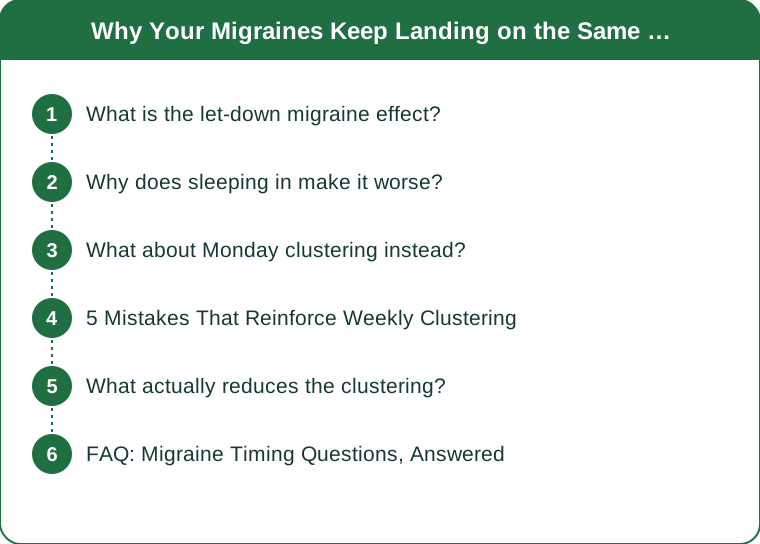
What is the let-down migraine effect?
Cortisol has a protective effect against migraine while it is elevated. When it falls, that protection lifts, and the trigeminovascular system becomes more reactive.
Studies tracking attack timing against stress ratings found that the risk peaks in the 6 to 18 hours after a period of high stress ends, not during it. That is why you get through the presentation fine and then get flattened that evening.
So a demanding Monday-through-Friday produces a Friday night or Saturday morning attack with clockwork reliability. The trigger was Thursday. The attack is Saturday. The tracker only records Saturday.
Why does sleeping in make it worse?
Two mechanisms stack. First, caffeine withdrawal: if you drink coffee at 7 am on weekdays and 10 am on Saturday, you have created a three-hour withdrawal window, and withdrawal headache is a well-established migraine trigger.
Second, sleep architecture. Sleeping two hours later shifts your circadian phase, and both oversleeping and undersleeping are documented triggers. The brain is not asking for more sleep; it is asking for the same sleep.
A 90-minute lie-in is usually tolerated. Beyond that, risk climbs noticeably. This is the single most modifiable factor in weekend clustering, and it is the one people resist most.
What about Monday clustering instead?
Monday attacks follow a mirror-image pattern. Instead of let-down, you get abrupt re-loading: sleep debt from a shifted weekend, a sudden return to screen and posture stress, and often a skipped or rushed breakfast.
Monday clustering also shows up in people who caffeinate heavily on weekdays and lightly on weekends. Monday morning is then a re-escalation, and rapid changes in either direction provoke attacks.
Either pattern points at the same fix. The body wants consistency across all seven days more than it wants any particular level of anything.

5 Mistakes That Reinforce Weekly Clustering
1. Treating the tracker date as the trigger date. Log what happened 12-24 hours before the attack, not just the day of. Most trigger diaries are looking at the wrong day entirely.
2. Sleeping in more than 90 minutes. The most common weekend amplifier and the easiest to change.
3. Delaying the first caffeine. Keep the timing constant even if you change the amount. A small coffee at your usual hour beats a large one three hours late.
4. Skipping the weekend meal that anchors blood sugar. Brunch instead of breakfast leaves a long fasting window on top of everything else.
5. Front-loading the week and collapsing on Friday. The steepest stress gradients produce the worst let-down, and this is the one that surprises even people who have tracked for years.
What actually reduces the clustering?
Flatten the gradients. All of them.
- Keep wake time within 60-90 minutes across all seven days
- Keep first caffeine within the same window daily
- Eat within an hour of waking regardless of the day
- Move some recovery into the workweek instead of banking it all for the weekend
- Hydrate on the same schedule; weekend hydration typically drops without anyone noticing
Give it four to six weeks before judging. Weekly clustering took months to establish and it unwinds on a similar timescale.
This is general information, not medical advice. If your pattern changed suddenly, attacks are getting more frequent, or you have new neurological symptoms, see a clinician rather than adjusting your schedule.
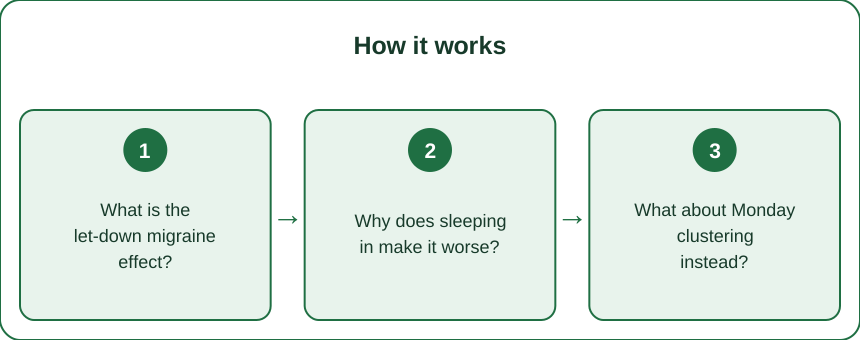
FAQ: Migraine Timing Questions, Answered
Is weekend migraine the same as a caffeine headache?
They overlap and are not identical. A caffeine withdrawal headache typically resolves within an hour of caffeine; a let-down migraine often does not.
Should I quit caffeine entirely?
Not necessarily, and quitting abruptly is its own trigger. Consistency matters more than quantity. If you do reduce, taper over several weeks.
Does exercise help or hurt?
Regular moderate aerobic exercise reduces attack frequency over time. Sudden intense exercise after a sedentary week can provoke an attack, which is another argument for spreading it across the week.
TL;DR:
- Attacks fire as stress hormones fall, typically 6-18 hours after the stress ends
- Sleeping in past 90 minutes and delaying first caffeine amplify the weekend pattern
- Log the 24 hours before an attack, not just the day of
- Flattening weekday-to-weekend gradients is the highest-yield change
Start with wake time. Set the same alarm seven days a week for one month and keep logging. It is the least appealing suggestion on this list and consistently the one that moves the pattern most.
Keep Reading
This article is for general informational purposes only and is not medical advice. Always consult a qualified health professional for guidance specific to you.