Why Your Migraine Medication Stops Working - and What a Rebound Headache Actually Feels Like
Quick Answer: When acute migraine medication is used more than about 10-15 days a month, it can start causing headaches rather than relieving them. This is called medication overuse headache, and the classic pattern is more frequent, duller, more constant headaches that respond less and less to the same drug. The threshold differs by drug class - roughly 10 days a month for triptans and combination analgesics, 15 for simple pain relievers.
It is common, it is under-recognized, and it is reversible - but reversing it requires a plan made with a clinician, not a solo attempt.
This is general information, not medical advice. Do not change how you take a prescribed medication based on an article.

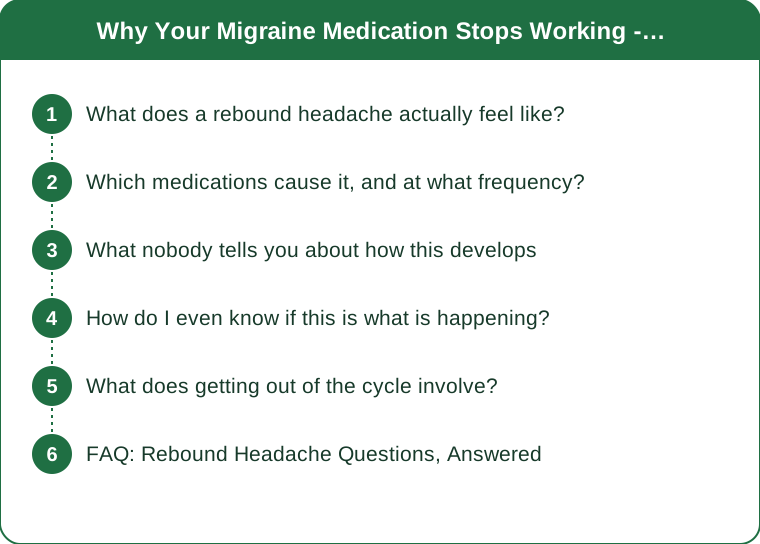
What does a rebound headache actually feel like?
It is often described as different from the original migraine, which is why it goes unrecognized for so long.
The typical picture:
- Present on waking, most days, rather than arriving as a discrete attack.
- Duller and more diffuse - a constant pressure rather than the throbbing, often one-sided quality of a classic migraine.
- Less associated with aura, nausea, or light sensitivity, though people who have migraine still get real migraine attacks on top of it.
- Temporarily relieved by the medication, then returning within hours as the dose wears off.
- Gradually increasing in frequency over weeks to months.
The defining feature is that phrase in the middle: it responds to the drug and then comes back. That cycle - relief, return, redose - is the loop that sustains it.
If you are taking something for headache on more days than not, this is worth raising at your next appointment regardless of what you think is causing it.
Which medications cause it, and at what frequency?
The thresholds are reasonably well established in headache medicine.
Around 10 days per month or more:
- Triptans (sumatriptan, rizatriptan, and others)
- Combination analgesics - anything mixing a pain reliever with caffeine
- Opioids and butalbital-containing medications, which carry the highest risk
- Ergotamines
Around 15 days per month or more:
- Simple analgesics used alone - acetaminophen, ibuprofen, naproxen, aspirin
Lower risk: the newer gepant class has not shown the same overuse pattern in available data, and preventive medications are a different category entirely - they are meant to be taken daily.
The counting detail people miss: it is days per month, not doses. Taking two tablets on one day is one day. And it is cumulative across drugs - five days of a triptan plus eight days of ibuprofen is thirteen days of acute treatment, not two separate safe counts.
That cumulative point is the one that catches most people out.
What nobody tells you about how this develops
Several things that make this hard to catch from the inside.
It develops slowly enough to feel like disease progression. The natural interpretation is ‘my migraines are getting worse,’ which leads to taking more medication, which accelerates the cycle. The pattern is self-reinforcing in the most understandable way possible.
Caffeine counts. Not just in combination tablets - habitual high caffeine intake is itself associated with headache frequency, and abrupt caffeine drops trigger withdrawal headaches. Two cups a day is not the issue; five is worth examining.
Over-the-counter medication is the most common culprit, precisely because it does not feel like real medication. Nobody counts ibuprofen days.
It is common. Medication overuse headache affects a meaningful share of people with chronic daily headache seen in specialist clinics - it is not a rare edge case.
It is reversible. This is the important part. Most people improve substantially within weeks to a couple of months of appropriate withdrawal, done with clinical support.

How do I even know if this is what is happening?
Track it, because memory is unreliable here in a very specific direction - people consistently underestimate their own medication days.
Keep a two-month headache diary with three columns: date, headache yes/no with rough severity, and every medication taken including over-the-counter.
Then count. If acute medication days are 10 or more per month for two consecutive months, bring the diary to your doctor. The diary itself is the most useful thing you can hand a clinician - far more useful than a verbal estimate.
Other signals worth noting: the medication working less well than it used to, needing it earlier in an attack, headaches present on waking, and a headache pattern that has shifted from episodic attacks to near-daily background pain.
Seek prompt medical attention regardless of any of this for a sudden severe headache unlike your usual, headache with fever or neck stiffness, headache after a head injury, new neurological symptoms, or a headache pattern that changes abruptly. Those need evaluation on their own terms.
What does getting out of the cycle involve?
Broadly, withdrawal of the overused medication plus a preventive strategy - and that combination is why this needs a clinician.
What typically happens: a supervised reduction or stop of the offending medication, often alongside starting a preventive medication so you are not left with nothing. There is usually a rough patch of days to a couple of weeks where headaches temporarily worsen before improving. Knowing that in advance is most of what makes it survivable.
Why solo attempts commonly fail: the withdrawal period is genuinely difficult, there is no bridge therapy, and people reasonably reach for relief on day four. A plan built in advance - including what you are allowed to take during withdrawal - changes the outcome substantially.
What helps alongside it: consistent sleep and wake times, regular meals, hydration, and managing the stress load, all of which matter more during withdrawal than at any other time.
Do not stop any prescribed medication abruptly on your own - some, including butalbital-containing drugs and opioids, require medically supervised tapering for safety reasons. Book the appointment; bring the diary.
FAQ: Rebound Headache Questions, Answered
If I only take ibuprofen, can this really happen?
Yes. Simple over-the-counter analgesics are associated with medication overuse headache at roughly 15 or more days per month. Being available without a prescription does not mean it is exempt.
Does this mean my migraines were never real?
No. Medication overuse headache develops on top of an existing headache disorder - it does not replace it or invalidate it. You have both, and treating one makes the other easier to manage.
How long until things improve after stopping?
Most reported improvement occurs within 2-8 weeks of withdrawal, with the hardest stretch in the first one to two weeks. Your clinician can set expectations for your specific medication.
This article is general information and not a substitute for medical advice. Talk to your doctor or a headache specialist about your own situation.
TL;DR:
- Acute migraine medication used 10-15+ days a month can start causing headaches - this is medication overuse headache.
- The pattern: duller, more constant, present on waking, relieved briefly then returning.
- Count days, not doses, and count across all drugs including over-the-counter.
- Keep a two-month diary with every medication logged - it is the most useful thing to bring a doctor.
- It is reversible, but withdrawal needs a clinical plan; never stop a prescribed medication abruptly on your own.
If you read the first section and recognized yourself, the next step is small: start the diary today and book the appointment. This is general information, not medical advice.
Keep Reading
This article is for general informational purposes only and is not medical advice. Always consult a qualified health professional for guidance specific to you.