Why Migraine Triggers Are Harder to Identify Than They Seem
Quick Answer: Many suspected triggers are actually prodrome symptoms - the attack has already begun, hours before the headache, and the prodrome causes food cravings, neck stiffness, yawning, and light sensitivity. The chocolate craving is often the attack starting, not the cause of it. This is why food diaries so often produce confident-but-wrong conclusions. More reliable culprits are sleep disruption, skipped meals, dehydration, hormonal shifts, and weather changes - and the highest-value thing to track is not food but timing regularity.
This reframe saves a lot of unnecessary dietary restriction.

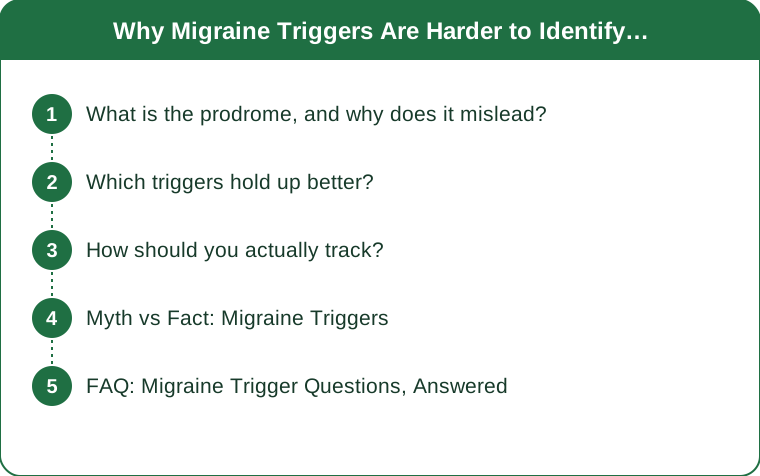
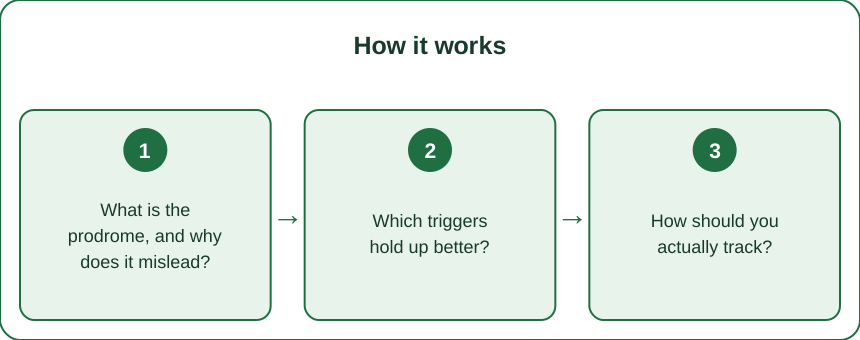
What is the prodrome, and why does it mislead?
It is the first phase of an attack, and it starts long before the pain.
Prodrome symptoms can begin 24 to 48 hours before the headache. Yawning, fatigue, mood change, neck stiffness, food cravings, increased thirst, and sensitivity to light or sound.
Every one of those can look like a cause. You crave chocolate, eat it, get a migraine, and conclude chocolate is a trigger. The craving was generated by the attack that was already underway.
Neck stiffness is the most commonly misattributed one. People blame their pillow, their desk, or a workout. Neck pain is a very common prodrome and early-attack symptom rather than a cause.
Light sensitivity in the prodrome makes ordinary light feel harsh, so bright light gets blamed. Sometimes light genuinely is a trigger; often it is an early symptom being noticed.
The practical implication: anything you notice in the 24 hours before an attack is as likely to be an early symptom as a cause. To separate them you need exposures you can time precisely and repeat - which food cravings, by their nature, are not.
And there is a hopeful side to this. Learning to recognise your own prodrome is genuinely useful, because acute treatment taken early is more effective than treatment taken once the pain is established.
Which triggers hold up better?
The ones that are external, measurable, and not plausibly generated by the attack itself.
Sleep disruption, in either direction. Too little and too much both feature, and irregular timing appears to matter more than total duration. Weekend lie-ins are a well-recognised pattern.
Skipped or delayed meals. One of the more consistently reported triggers, and one of the easiest to act on. Regular meal timing is a low-cost intervention with a reasonable evidence base.
Dehydration. Frequently reported, easy to address, and worth handling regardless.
Hormonal fluctuation. Menstrual migraine is well documented, typically clustering around the drop in oestrogen before menstruation. This is one of the most predictable patterns available, which makes it useful for planning preventive treatment.
Stress - and specifically the let-down after it. Attacks commonly appear on the first day off or the start of a holiday rather than during the busy period. This is a recognised pattern, and it is why people misread their own stress relationship.
Weather changes, particularly barometric pressure. Reported by many people; the research is mixed, and the effect appears real for some individuals and absent for others. Autumn’s unstable pressure is a common time for this to become noticeable.
And the important nuance: triggers are usually cumulative. A single factor often does nothing; three together crosses a threshold. This is why the same food seems to trigger an attack sometimes and not others - it was never the food alone.

How should you actually track?
Track fewer things, more precisely, over a longer period.
Track the day before, not just the day of. Note sleep timing and duration, meal timing, hydration, stress, and cycle day - and record them daily whether or not an attack occurs. A diary that only gets filled in on bad days cannot show you anything, because you have no comparison.
Include timing, not just presence. Ate lunch at 2pm instead of 12 is far more informative than ate lunch. Timing regularity is the pattern that most often emerges.
Give it eight to twelve weeks. Migraine frequency varies enough that shorter periods produce noise. Most confident trigger conclusions come from too little data.
Note prodrome symptoms separately from suspected triggers. Two columns: what I noticed and what I did. This single structural change prevents most of the misattribution the diary would otherwise produce.
Do not eliminate foods pre-emptively. Broad elimination diets frequently produce nutritional gaps and rarely produce clear answers, because the cumulative-threshold effect means single-food tests are unreliable.
Bring the diary to a clinician. A structured diary is genuinely useful in a consultation, and it makes the difference between I get headaches and a pattern that can be treated. Migraine is treatable, and preventive options have expanded considerably in recent years - a diary is the best preparation for that conversation.
This is general information, not medical advice.
Myth vs Fact: Migraine Triggers
Myth: Chocolate is a common migraine trigger. Fact: Controlled studies have struggled to confirm it, and the craving is a recognised prodrome symptom. Chocolate is one of the most commonly blamed and least well supported suspects.
Myth: Red wine, cheese, and processed meats are established triggers for most people. Fact: They are reported by some individuals and the evidence at population level is much weaker than the reputation suggests. Alcohol generally is better supported than any specific food - and dehydration and sleep disruption may carry much of that effect.
Myth: If you find your trigger, you can stop having migraines. Fact: Migraine is a neurological condition with a strong genetic component. Trigger management reduces frequency; it does not remove the underlying condition. Framing it as a puzzle to be solved sets up avoidable disappointment.
Myth: Stress causes attacks during the stressful period. Fact: The let-down pattern - attacks appearing as stress lifts - is well recognised. Blaming the busy week can point you at the wrong day entirely.
Myth: A headache diary means writing down everything you eat. Fact: Food is the least reliable category. Sleep timing, meal timing, hydration, cycle day, and stress produce far more actionable patterns, and take a fraction of the effort to record.
FAQ: Migraine Trigger Questions, Answered
Why does the same food trigger an attack only sometimes?
Because triggers appear to be cumulative rather than absolute. One factor often does nothing; several together cross a threshold. This is also why single-food elimination tests so often give inconsistent results.
What is the prodrome?
The first phase of an attack, beginning up to 24 to 48 hours before the headache. Yawning, mood change, neck stiffness, food cravings, and thirst are common. Recognising it is useful because early treatment works better.
How long should I keep a diary?
Eight to twelve weeks, filled in daily rather than only on attack days. Shorter periods and attack-only records produce confident conclusions that do not hold up.
Should I eliminate common trigger foods?
Generally not pre-emptively. Broad elimination rarely produces clear answers and can create nutritional gaps. Track first, and discuss any planned elimination with a clinician or dietitian.
Is neck pain a trigger or a symptom?
Much more often a symptom - neck pain is very common in the prodrome and early attack phases. Blaming posture or a pillow is one of the most frequent misattributions.
When should I see a doctor?
If attacks are frequent, worsening, or interfering with daily life; if the pattern changes; or if you experience sudden severe headache, headache with fever or neurological symptoms, or your first migraine-like headache after 50. Preventive treatment options have expanded significantly and are worth discussing.
TL;DR:
- Many suspected triggers are prodrome symptoms - the attack starts up to 24 to 48 hours before the pain and generates cravings, neck stiffness, and light sensitivity.
- Chocolate is the classic misattribution; the craving is usually the attack beginning.
- Better-supported factors: sleep and meal timing irregularity, dehydration, hormonal shifts, stress let-down, and weather changes.
- Triggers are cumulative - one factor often does nothing, three together cross a threshold.
- Track daily for 8 to 12 weeks, record timing not just presence, and keep prodrome symptoms in a separate column.
The most useful shift is from hunting a culprit to managing a threshold - and taking the diary to a clinician, because migraine is treatable and the preventive options have improved a great deal.
This is general information, not medical advice.
Keep Reading
This article is for general informational purposes only and is not medical advice. Always consult a qualified health professional for guidance specific to you.