Why Migraines Cluster on Weekends — the Let-Down Effect Explained
Quick Answer: Weekend migraines are usually a combination of three things: a delayed or reduced first coffee (caffeine withdrawal), sleeping later than usual (circadian shift), and the ‘let-down effect’ — a drop in cortisol after a stressful week that is a well-documented migraine trigger. Keeping caffeine timing and wake time within an hour of weekday norms prevents a large share of them.
You get through a demanding week fine. Saturday at 10am you are in a dark room.
This pattern is common enough to have a name, and most of it is preventable without giving up your weekend.

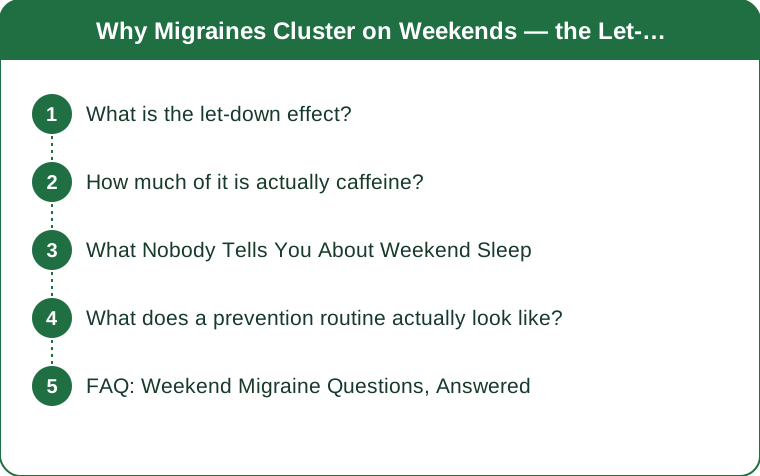
What is the let-down effect?
A migraine triggered by the relief of stress rather than the stress itself.
The mechanism is a hormonal drop, not a rise. During a stressful period, cortisol stays elevated. When the stressor ends, cortisol falls — and that decline is associated with migraine onset in a substantial proportion of people who track it.
Research has documented the pattern. Studies asking migraine patients to log stress levels alongside attacks have found elevated risk in the 6 to 18 hours after a decline in perceived stress, with some analyses showing roughly a five-fold increase in odds during that window.
It explains the vacation headache too. The first day or two of a holiday is a classic onset window for exactly the same reason.
It is not psychological in the dismissive sense. The trigger is a measurable physiological transition. Being told your weekend headache is ‘just stress’ misses that the timing points to a specific and addressable mechanism.
And it means the intervention is different from ordinary stress management. You are not trying to have less stress on the weekend — you are trying to make the transition less abrupt.
How much of it is actually caffeine?
More than most people expect, and it is the easiest variable to control.
Caffeine withdrawal headaches begin 12 to 24 hours after the last dose and peak around 24 to 48 hours. A weekday coffee at 7am followed by a weekend coffee at 10am creates a three-hour extension that lands squarely in the onset window.
Total amount matters less than timing consistency. Someone drinking two cups daily at consistent times has fewer withdrawal issues than someone drinking four cups at wildly varying times.
Weekend caffeine often drops in quantity too. No office coffee machine, no afternoon meeting cup. The intake can halve without any deliberate decision.
The fix is unglamorous: drink your first coffee within an hour of your weekday time, even if you go back to bed afterward. Many people report this alone cuts weekend attacks substantially.
If you want to reduce caffeine overall, do it on a Tuesday. Tapering during a period of stable routine avoids stacking withdrawal on top of the let-down effect and the sleep shift at the same time.

What Nobody Tells You About Weekend Sleep
Sleeping in is the intervention that feels most restorative and causes the most trouble.
A two-hour sleep-in is a two-hour time zone change. Your circadian system treats a delayed wake time as travel. Migraine is strongly linked to circadian disruption, and a weekly two-hour shift in each direction is a recurring insult.
Both directions are triggers. Oversleeping and undersleeping both appear in migraine trigger surveys. There is no safe side to err on — consistency is the variable, not duration.
The Sunday night problem is the same phenomenon in reverse. Shifting back to a weekday wake time on Monday creates a second transition, which is part of why Monday attacks are also common.
One hour is the practical tolerance. Most people can shift their wake time by about an hour without measurable consequence. Beyond that the risk rises noticeably.
The compromise that works: get up within an hour of your weekday time, have your coffee, and nap in the early afternoon if you need more sleep. A 20 to 30 minute early-afternoon nap does not disturb the circadian anchor the way a delayed wake time does — and this is the piece almost nobody is told.
What does a prevention routine actually look like?
Five habits, none of which require giving up a relaxed weekend.
Wake within one hour of your weekday time, seven days a week. This is the highest-value single change.
First caffeine within one hour of your weekday time, at the same approximate dose.
Eat breakfast within two hours of waking. Skipped or delayed meals are among the most consistently reported triggers, and weekend mornings are when meals get delayed most.
Taper the week rather than dropping it. If Friday evening is when everything stops at once, add a low-demand activity Friday night — a walk, light exercise, something structured — to soften the cortisol transition rather than letting it cliff.
Hydrate on Friday and Saturday morning specifically. Weekend alcohol, later meals, and more caffeine variability all compound; a deliberate 500ml on waking is trivially easy and removes one variable.
This is general information, not medical advice. If your headache pattern changes, becomes more frequent, is the worst you have experienced, or comes with visual, speech, or weakness symptoms, see a healthcare professional promptly rather than adjusting your routine.
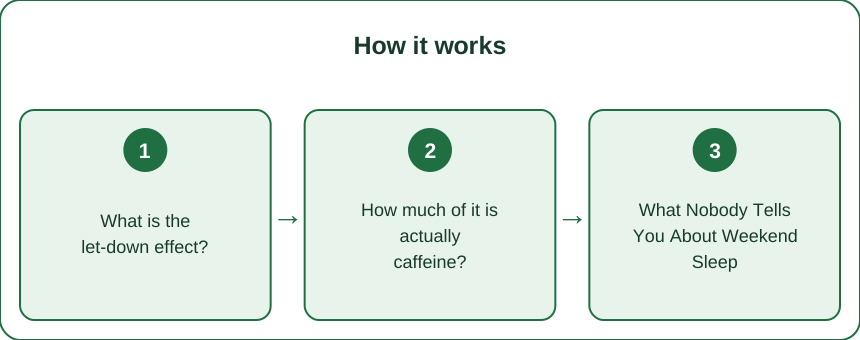
FAQ: Weekend Migraine Questions, Answered
How do I know if mine is caffeine withdrawal or the let-down effect?
Run the caffeine variable alone for three weekends: same time, same dose as weekdays, everything else unchanged. If attacks drop substantially, caffeine timing was the main driver. If they continue at the same rate with the same timing, the let-down effect and sleep shift are more likely, and those need the wake-time fix.
Does this mean I can never sleep in?
You can, and the cost is usually a delayed wake time rather than extra sleep specifically. Going to bed an hour earlier on Friday and waking at your usual time gives you the extra sleep without the circadian shift. Add an afternoon nap if that is not enough. The rule to protect is the wake time, not the total.
Why do my weekend migraines seem worse in the fall?
Shortening daylight makes the circadian anchor weaker, so the same two-hour sleep-in has a larger effect than it did in June. Barometric pressure swings also increase through the autumn, and pressure changes are a widely reported trigger. If your pattern intensifies in September and October, tightening the wake-time consistency matters more in those months, not less.
TL;DR:
- Weekend migraines usually stack three triggers: caffeine timing shift, delayed wake time, and the post-stress cortisol drop.
- The let-down effect is documented — risk rises in the 6 to 18 hours after stress declines.
- Keep wake time and first caffeine within an hour of weekday norms; nap in the early afternoon if you need more sleep.
- Test the caffeine variable alone for three weekends to find out which driver is yours. The wake-time rule is the one worth trying first. It costs one hour of a Saturday morning and it is the change people report the largest difference from.
Keep Reading
This article is for general informational purposes only and is not medical advice. Always consult a qualified health professional for guidance specific to you.