Why Migraines Often Strike the Day After a Stressful Week Ends, Not During It
Quick Answer: So-called ‘let-down migraines’ happen when cortisol and adrenaline, which had been elevated and suppressing pain sensitivity throughout a stressful stretch, drop suddenly once the stress resolves — that abrupt hormonal shift, not the stress itself, is what commonly triggers a migraine in the hours or day right after the pressure lifts, which is why weekends and vacations are a surprisingly common migraine trigger point.
The hardest week of the month came and went without a single migraine. Then, the first quiet Saturday morning, it hit hard. This isn’t bad luck — it’s a well-documented pattern with a specific hormonal explanation.

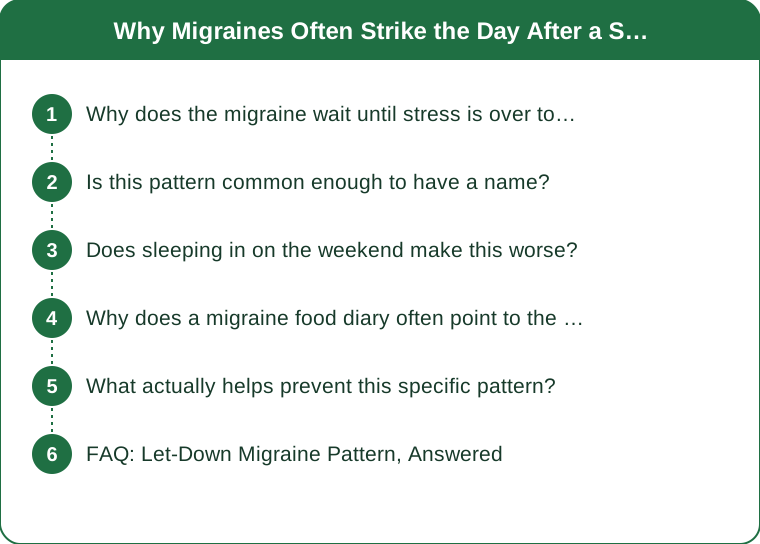
Why does the migraine wait until stress is over to actually show up?
During acute stress, elevated cortisol and adrenaline have a natural pain-suppressing effect, partly explaining why the stressful period itself often passes without a migraine. Once the stressor resolves, those hormone levels drop relatively quickly, and that drop itself — not the earlier stress — is understood to be a meaningful migraine trigger for people prone to them.
Is this pattern common enough to have a name?
Yes — it’s frequently referred to as a ‘let-down migraine’ or ‘weekend migraine,’ and it’s a recognized pattern in headache medicine, not an unusual individual quirk. People who experience it often notice it clusters specifically around the transition from a demanding period into a lower-stress one, rather than during the demanding period itself.
Does sleeping in on the weekend make this worse?
It can contribute — significant changes in sleep timing, even sleeping later than usual, are a separate but related migraine trigger, and weekends often combine both the stress let-down effect and a shifted sleep schedule at the same time, compounding the risk in a way weekdays with a consistent routine don’t.

Why does a migraine food diary often point to the wrong trigger in these cases?
If the migraine hits the day after the stressful trigger rather than the same day, a food or activity diary looking only at same-day correlations will often miss the actual cause, incorrectly flagging something eaten the day of the migraine rather than the stress-hormone drop from the day before that was the real driver.
What actually helps prevent this specific pattern?
Keeping sleep timing and meal timing as consistent as possible even as work stress decreases (not sleeping in dramatically later, not skipping regular meals just because the pressure is off) helps smooth the hormonal transition rather than letting it swing sharply, which appears to reduce how often the let-down pattern triggers a migraine.
FAQ: Let-Down Migraine Pattern, Answered
Is a let-down migraine different from a regular stress migraine?
It’s related but distinct — a regular stress migraine can occur during acute stress itself, while a let-down migraine specifically follows the resolution of that stress, driven by the hormonal drop rather than the stress peak.
Can staying consistently busy prevent a let-down migraine?
Not reliably, and it isn’t a sustainable prevention strategy — the more practical approach is smoothing the transition (consistent sleep and meal timing) rather than avoiding rest altogether.
Should this pattern be discussed with a doctor?
Yes, if it happens repeatedly — a headache specialist can help identify whether preventive strategies or medication timing adjustments specifically address this let-down trigger pattern for your case.
TL;DR:
- A sudden drop in cortisol and adrenaline after stress resolves, not the stress itself, is the likely trigger
- ‘Let-down’ or ‘weekend’ migraines are a recognized, well-documented pattern in headache medicine
- Sleeping in and shifted meal timing on weekends can compound the hormonal transition risk
- Consistent sleep and meal timing, even once stress lifts, helps smooth this transition and reduce triggers
This is general information, not medical advice — talk to a headache specialist if this pattern happens regularly, since preventive strategies can specifically target it.
Keep Reading
This article is for general informational purposes only and is not medical advice. Always consult a qualified health professional for guidance specific to you.