Why a Migraine Food Diary Often Points to the Wrong Trigger
Quick Answer: Migraine food diaries frequently misidentify triggers because cravings for certain foods (like chocolate or sugar) are often an early symptom of an oncoming migraine rather than its cause — the food gets blamed when it was actually a signal the migraine process had already begun.
A slice of chocolate cake, a migraine two hours later — the conclusion feels obvious. The research on prodrome symptoms tells a more complicated story.

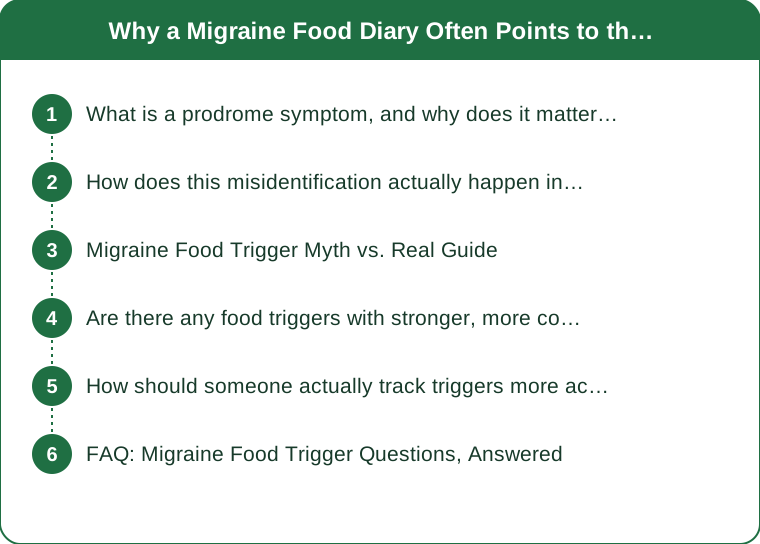
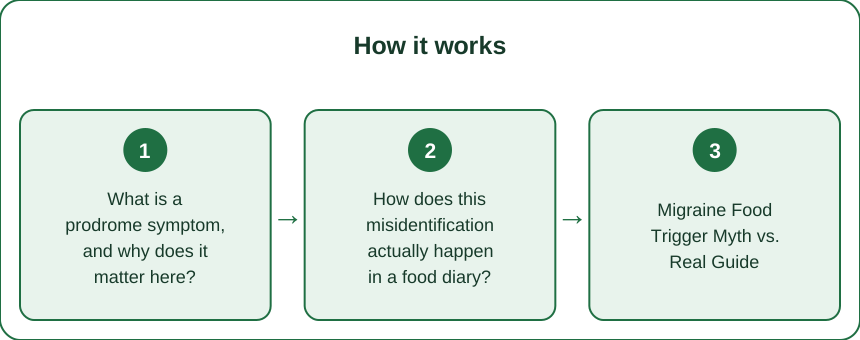
What is a prodrome symptom, and why does it matter here?
The prodrome phase is an early stage of a migraine attack, sometimes beginning up to 24-48 hours before the headache itself, that can include specific food cravings, along with mood changes, neck stiffness, or unusual fatigue.
A craving for chocolate or sugar during this phase is a commonly reported prodrome symptom, meaning the food consumed afterward may be a response to the oncoming migraine, not its trigger — the sequence gets misread as cause and effect.
How does this misidentification actually happen in a food diary?
A food diary logs what was eaten and then notes the migraine that followed, but without accounting for the prodrome window, it can’t distinguish between “this food caused the migraine” and “I craved this food because a migraine was already starting.**
This is a well-documented confound in migraine trigger research specifically, and it’s part of why food-elimination approaches based purely on diary correlation often fail to actually reduce migraine frequency.
Migraine Food Trigger Myth vs. Real Guide
Myth: Any food consumed within a few hours before a migraine is a likely trigger. Fact: without accounting for prodrome timing, a food diary can’t reliably separate true triggers from prodrome-driven cravings — a more rigorous approach tracks symptoms over the preceding 24-48 hours, not just the meal right before.
Myth: Chocolate is a proven, universal migraine trigger. Fact: controlled trials specifically testing chocolate as a migraine trigger have had inconsistent, often null results, suggesting its reputation may be substantially explained by the prodrome-craving confound.

Are there any food triggers with stronger, more consistent evidence?
Alcohol, particularly red wine, has more consistent evidence as an actual migraine trigger across multiple studies, distinguishing it from foods more likely explained by prodrome cravings.
Dehydration, whether or not tied to a specific food, has some of the more consistently supported trigger evidence overall, making it worth tracking alongside food intake rather than treating food as the sole variable.
How should someone actually track triggers more accurately?
Logging symptoms starting 24-48 hours before a migraine, not just the meal immediately prior, helps distinguish prodrome cravings from genuine triggers over enough tracked cycles to see a pattern.
Tracking sleep, stress, hydration, and hormonal cycle alongside food gives a fuller picture, since migraines are frequently multi-factorial rather than driven by a single identifiable food trigger.
FAQ: Migraine Food Trigger Questions, Answered
Should I stop tracking food entirely since it might be misleading?
No — food tracking is still useful, just alongside prodrome symptom tracking and other factors like sleep and stress, rather than in isolation.
Is it worth doing a full elimination diet to identify triggers?
Some people find it helpful, but it’s best done under guidance from a healthcare provider, since unsupervised elimination diets can lead to unnecessary restriction without actually improving migraine frequency.
How long does it typically take to identify a real pattern?
Most specialists suggest tracking for at least 2-3 months, since migraine patterns can be inconsistent and short tracking windows often don’t reveal reliable trends.
TL;DR:
- Food cravings during the prodrome phase can precede a migraine as a symptom, not a cause
- A food diary that only logs the meal right before a migraine can’t distinguish trigger from craving
- Chocolate’s reputation as a trigger may be substantially explained by this prodrome confound
- Alcohol and dehydration have more consistent trigger evidence than most specific foods
The food diary isn’t useless — it’s just incomplete without tracking the days before, not just the meal right before. This is general information, not medical advice.
Keep Reading
This article is for general informational purposes only and is not medical advice. Always consult a qualified health professional for guidance specific to you.